
 By
By 
Many children can score well on tests but feel unsure when they face open-ended problems. STEM education helps close that gap by giving children hands-on practice with science, technology, engineering, and mathematics in one connected learning experience.
Instead of memorising facts separately, children build, test, code, measure, and explain their thinking. This helps them become more confident problem-solvers who can adapt when a task does not have one obvious answer.
Meta Robotics supports children aged 3 to 16 through robotics and coding programmes guided by its NEBULA™ Neuro-Builder model, which helps young learners develop logical thinking, creativity, focus, resilience, and confidence through structured hands-on challenges.
What Is STEM Education?
STEM education combines Science, Technology, Engineering, and Mathematics. In a good STEM lesson, children do not only read about concepts. They use those ideas to complete a practical task.
For example, a child may:
-
Build a bridge and test how much weight it holds
-
Code a game and fix errors
-
Design a robot to move through a path
-
Measure speed, distance, or height
-
Compare different solutions
-
Explain why one design works better than another
This style of learning helps children understand how school subjects connect to the real world.
Why STEM Matters for Children in Singapore
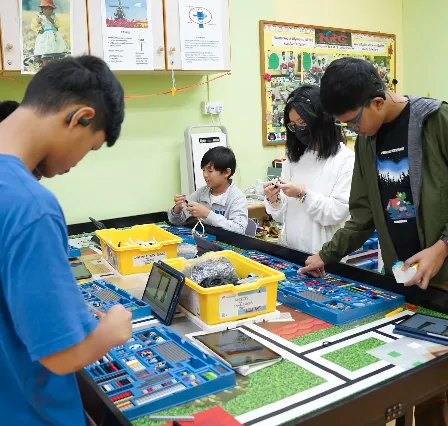
Singapore’s future will continue to involve technology, automation, data, robotics, and digital tools. Children who are comfortable with STEM thinking can approach these changes with confidence instead of fear.
STEM education helps children build:
-
Problem-solving skills
-
Logical thinking
-
Creativity
-
Patience
-
Teamwork
-
Communication
-
Confidence with technology
-
Resilience when things fail
These skills are useful not only for future engineers or programmers. They are also valuable in design, healthcare, business, research, education, finance, and many other fields.
How STEM Builds Problem-Solving Skills
STEM teaches children to break large problems into smaller steps. This is especially useful when the answer is not obvious.
A typical STEM process may look like this:
-
Understand the problem
-
Plan a solution
-
Build or code the idea
-
Test the result
-
Find what went wrong
-
Improve the design
-
Explain the final solution
This process helps children learn that mistakes are not failures. They are clues that guide the next improvement.
At Meta Robotics, children learn through hands-on robotics, coding, games, animation, and project work. The goal is to help them think clearly, stay curious, and keep improving.
STEM Learning by Age Group
Ages 3 to 4: Early STEM Exploration
Young children can begin with simple building, sorting, counting, movement, and cause-and-effect activities. The focus should be curiosity, fine motor skills, language, and confidence.
Meta Robotics’ Adapter Programme introduces early Science and Mathematics through LEGO® brick activities for children aged 3 to 4.
Ages 5 to 6: First Robotics and Coding Concepts
Children at this age can begin simple robotics, coding ideas, animation, and guided STEM tasks.
Meta Robotics’ Ranker Programme supports children aged 5 to 6 with Robotics, STEM, Coding, and Animation while building creativity, patience, focus, and problem-solving.
Ages 7 to 9: Robotics and Coding Foundations
Lower primary children can handle more structured challenges. They can build robots, create simple games, and understand basic coding logic.
Meta Robotics’ High Ranker Programme helps children aged 7 to 9 connect Science, Mathematics, Coding, Games, and Design through hands-on projects.
Ages 10 to 12: Deeper STEM and Project Work
Upper primary students can begin more complex robotics projects, coding tasks, machine learning concepts, and competition preparation.
Meta Robotics’ Ace Programme supports children aged 10 to 12 with Robotics STEM, Robotics Coding, Machine Learning, Games, and Animation Computing.
Ages 13 and Above: Advanced Technology Skills
Teenagers can explore more advanced coding, robotics, design thinking, and emerging technology concepts.
Meta Robotics’ King Programme supports learners aged 13 and above with deeper Science, Mathematics, Coding, Design, and technology readiness.
How Parents Can Support STEM at Home
Parents do not need to be engineers or programmers. Simple questions can help children think more deeply.
Try asking:
-
What are you trying to build?
-
What did you test?
-
What changed after you improved it?
-
Why do you think it worked?
-
What would you do differently next time?
You can also encourage STEM habits through puzzles, building blocks, simple experiments, coding games, and everyday problem-solving at home.
FAQ
What is STEM education for kids?
STEM education teaches children to use science, technology, engineering, and mathematics together through hands-on projects, experiments, coding, and design challenges.
What age should children start STEM learning?
Children can begin STEM learning from around age 3 through play-based activities. More structured robotics and coding can begin from ages 5 to 6.
Does STEM education help with school learning?
Yes. STEM supports logical thinking, problem-solving, focus, and confidence, which can help children approach Science, Mathematics, project work, and presentations more effectively.
Does Meta Robotics offer STEM programmes in Singapore?
Yes. Meta Robotics offers age-based STEM, robotics, and coding programmes for children aged 3 to 16, including Adapter, Ranker, High Ranker, Ace, King, holiday workshops, and DSA preparation.







Comments